


B2B Service Page Copywriting for Qualified Leads

Learn how to write B2B service page copy that helps international buyers understand your value, reduce risk, and request qualified sales conversations.
Mariam Zamani
Published on December 27, 2025 · Updated April 28, 2026
Optional external content
This media loads from an external source and stays blocked until you accept optional cookies.
B2B Service Page Copywriting for International Service Businesses
Your Service Page Should Help Buyers Decide — Not Just Explain What You Do
In international B2B markets, your service page is often the first serious sales conversation a prospect has with your company. Before they book a call, request a quote, or reply to your outreach, they check one thing: does your website make the decision feel safe?
Most service pages fail because they describe the company instead of helping the buyer make progress. They list services, mention experience, add a contact button, and hope the visitor connects the dots.
A stronger B2B service page answers the buyer’s hidden questions:
- Is this service relevant to my business situation?
- Can this team understand the complexity behind the problem?
- What happens if I start a conversation?
- Why should I trust this provider more than the alternatives?
This guide shows how to write B2B website copy for service pages that create clarity, reduce perceived risk, and turn anonymous traffic into sales-qualified conversations.
For a broader view of website performance, read: common corporate website mistakes that prevent lead generation .
The Strategic Shift: From Service Description To Buyer Enablement
A service page is not a digital brochure. It is a buyer enablement asset. Its job is to help the right visitor understand the problem, compare options, recognize your fit, and take the next step with less uncertainty.
This matters especially for companies selling complex services such as:
- software development and product engineering
- SaaS consulting and implementation
- digital transformation and automation
- UI/UX design and conversion optimization
- B2B copywriting, SEO, and content strategy
- technical consulting, audits, and managed services
The goal is not to make the page sound more impressive. The goal is to make the buying decision easier.
1. Start With Buyer Intent, Not Company Messaging
A common mistake in B2B copywriting is starting with what the company wants to say. Effective service page copy starts with what the buyer is trying to solve.
Before writing the page, define the intent behind the visit. A visitor may be comparing vendors, validating your credibility after a referral, checking if you understand their industry, or looking for a safer alternative to their current provider.
Buyer-intent questions to answer before writing
- What problem made the visitor search, click, or open this page?
- What alternatives are they comparing?
- What risk are they afraid of?
- What would make them feel confident enough to book a call?
- What information does sales usually need to explain manually?
The best service pages do part of the sales work before the first meeting. They prepare the buyer, filter poor-fit leads, and make the first conversation more productive.
2. Build A Message Hierarchy That Moves From Relevance To Trust
Many B2B pages contain the right information in the wrong order. They mention process before relevance, features before pain, or company background before the buyer understands the value.
A stronger service page uses message hierarchy. That means each section appears when the buyer needs it.
A practical message hierarchy for B2B service pages
- 1. Relevance: show who the service is for and what business problem it solves.
- 2. Outcome: explain what improves after the work is done.
- 3. Method: show how you approach the problem.
- 4. Proof: support claims with examples, results, or process evidence.
- 5. Risk reduction: clarify scope, timeline, collaboration, and expectations.
- 6. Next step: make the consultation CTA specific and low-friction.
For more context on what belongs on a strong company website, read: essential content every corporate website should include .
3. Write A Hero Section That Qualifies The Right Buyer
The hero section should not try to say everything. Its job is to create enough clarity for the right visitor to continue.
A good B2B hero section should communicate the business outcome, the type of customer you serve, and the reason your approach is different.
Hero formula for international B2B service pages
Business outcome + buyer category + risk removed
- “Service page copy for B2B firms that need qualified consultation requests, not passive traffic.”
- “Conversion-focused website copy for SaaS, software, and consulting companies with complex buying cycles.”
- “Turn your service pages into buyer-ready sales assets with clearer messaging, stronger proof, and better CTAs.”
Avoid vague hero copy
Weak:
“We help businesses grow with innovative digital solutions.”
Stronger:
“We rewrite B2B service pages so more qualified buyers understand the offer and book a consultation.”
4. Turn Deliverables Into Decision Evidence
B2B buyers do not buy deliverables in isolation. They buy reduced uncertainty, faster internal alignment, stronger positioning, and better commercial outcomes.
Instead of listing what you do, explain why each deliverable matters and how it changes the buyer’s situation.
Deliverable explanation framework
- Problem: what friction exists today?
- Deliverable: what will you create?
- Use: how will the client use it?
- Commercial impact: what business decision or behavior should improve?
Messaging Audit
Problem: the page is unclear, generic, or too internally focused.
Deliverable: a review of positioning, audience fit, claims, objections, and CTA logic.
Impact: the company sees what prevents buyers from taking the next step.
Service Page Rewrite
Problem: the current page describes services but does not guide the buyer.
Deliverable: new page structure, headlines, body copy, proof sections, and CTA blocks.
Impact: clearer value, stronger trust, and a smoother path to consultation.
Form And Microcopy Optimization
Problem: visitors hesitate because the form feels unclear, demanding, or risky.
Deliverable: field labels, helper text, reassurance copy, and improved error messages.
Impact: fewer drop-offs and more completed requests from serious buyers.
5. Handle Buyer Objections Before The Sales Call
A strong service page does not avoid objections. It answers them before they become reasons to leave.
This is where many B2B pages lose conversions. They make claims but do not address the doubts a serious buyer already has.
Common buyer objections
- Will this work for our business model?
- Do you understand our technical or operational complexity?
- How much time will our team need to invest?
- What happens if the scope changes?
- How do we know this is not just marketing language?
- What makes you different from other providers?
Where to answer objections
- Answer fit-related doubts near the hero section.
- Answer process doubts in the “how it works” section.
- Answer credibility doubts near claims and proof blocks.
- Answer pricing doubts before the final CTA.
- Answer operational doubts in the FAQ.
6. Use Proof As A Navigation Tool, Not Decoration
Proof should appear where the buyer needs confidence. Many service pages place testimonials at the bottom, far away from the claims they support.
Better service page copy connects each major claim with a supporting proof element.
Useful proof formats for B2B service pages
- before/after examples of messaging or page structure
- short client quotes focused on business outcomes
- mini-cases with problem, action, and result
- process screenshots or workflow explanations
- specific numbers when available
- security, compliance, or delivery commitments when relevant
If your audience is in Germany or the EU, accessibility and compliance can also support trust. This guide may help: BFSG and European Accessibility Act website checklist .
7. Make The Consultation CTA Feel Like A Useful Diagnostic Step
“Contact us” is weak because it creates uncertainty. The visitor does not know what happens next, how much effort is required, or whether the conversation will be useful.
A better CTA frames the next step as a small diagnostic action with a clear benefit.
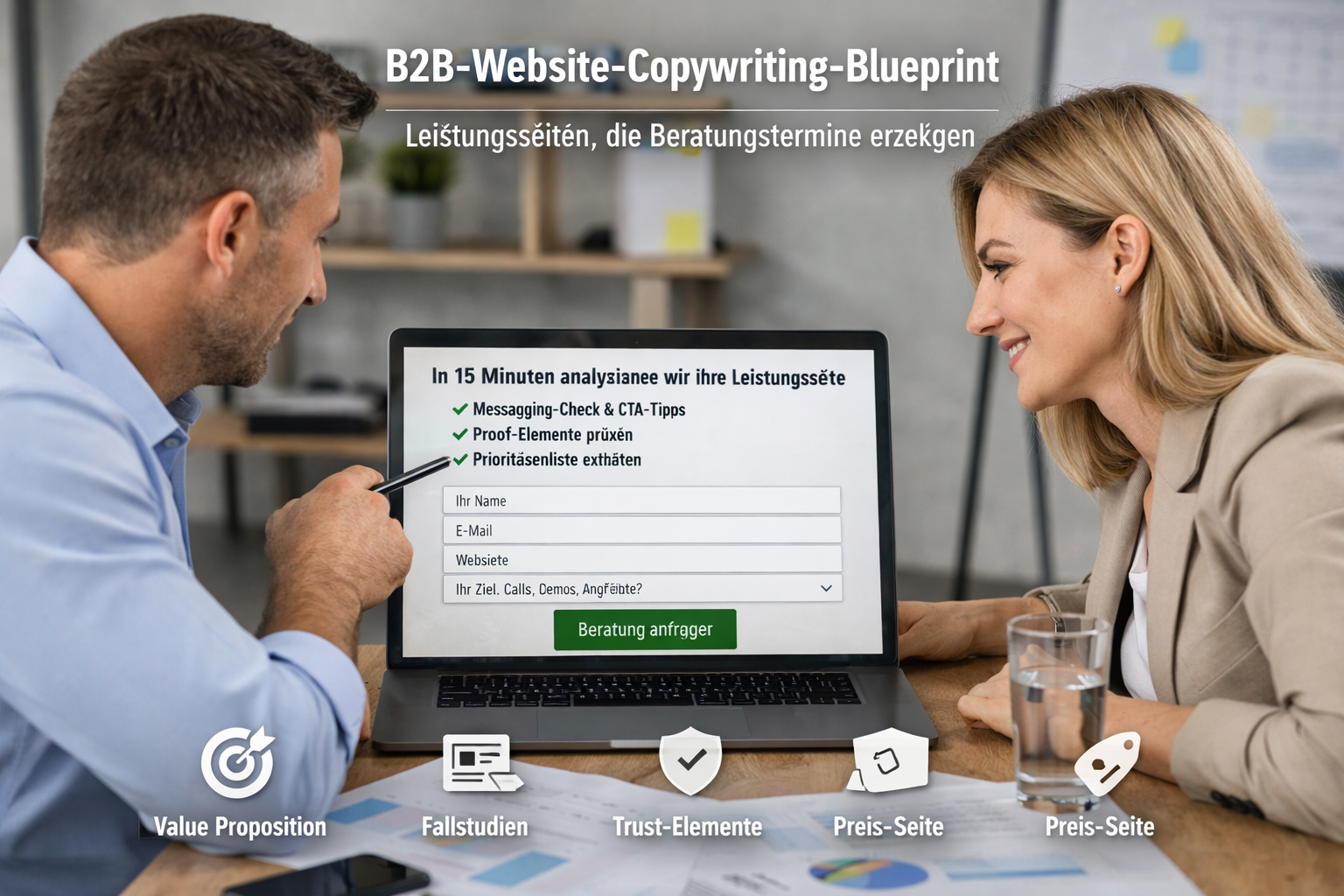
Consultation CTA template
“Get a practical review of your service page before you rewrite it.”
What the visitor receives:
- clarity gaps in the current page
- CTA and form friction points
- missing proof or trust signals
- recommended next steps based on priority
Form fields:
- Name
- Website URL
- One context question: “What should this page generate: calls, demos, quotes, or qualified leads?”
Reassurance copy:
- “No obligation.”
- “Your information stays confidential.”
- “You receive practical feedback, not a generic sales pitch.”
Better button labels
Weak:
Submit, Send, Contact Us
Stronger:
Request My Page Review, Get Feedback, Book A Consultation
8. Add Pricing Context Even When You Cannot Show A Fixed Price
Many B2B services cannot publish a fixed price because scope depends on complexity. That is reasonable. But no pricing context at all creates doubt.
The buyer may assume the service is too expensive, too slow, or too undefined. Pricing copy should reduce that uncertainty.
Three ways to add pricing clarity
- Scope drivers: explain what affects cost, such as number of pages, research depth, stakeholder interviews, or UX complexity.
- Project ranges: give a realistic starting point or typical range when possible.
- Engagement types: separate audits, rewrites, retainers, and full website messaging projects.
For a broader cost framework, read: what website costs and services you should realistically expect .
9. Write For Search Intent Without Turning The Page Into Keyword Wallpaper
SEO matters, but B2B service page copy should not read like a keyword list. The page needs to satisfy search intent and buying intent at the same time.
Use the main topic naturally in headings, introductions, examples, FAQs, and internal links. Then support it with related concepts that real buyers care about.
Useful supporting topics for this page
- B2B website copywriting services
- service page copywriting
- conversion copywriting for B2B
- consultation CTA optimization
- lead generation website copy
- sales-qualified conversations
- buyer enablement content
A Service Page Copy Framework You Can Use
Use this structure to plan or rewrite a B2B service page without starting from a blank screen.
1. Buyer-Relevant Hero
Outcome, audience, problem, and primary CTA.
2. Problem Context
Explain the cost of unclear messaging, weak positioning, or poor conversion flow.
3. Strategic Approach
Show how you diagnose, plan, write, test, and improve the page.
4. Deliverables With Business Purpose
Describe what the client receives and why it matters.
5. Objection Handling
Answer doubts about fit, scope, price, process, and credibility.
6. Proof Placement
Place examples, quotes, mini-cases, or numbers near the claims they support.
7. Pricing Context
Clarify scope drivers, engagement types, or project ranges.
8. Diagnostic CTA
Offer a specific next step with a clear benefit and low perceived risk.
9. FAQ
Answer operational, commercial, and decision-related questions.
How To Measure Whether Your Service Page Copy Works
Ranking is useful, but it is not the final business metric. A B2B service page should be measured by the quality and movement of buyer behavior.
Metrics worth tracking
- CTA click-through rate
- form completion rate
- number of qualified consultation requests
- lead fit based on sales feedback
- scroll depth around proof and CTA sections
- drop-off points in forms
- quality of questions prospects ask in the first call
To connect copy, UX, and visual structure, read: what modern web design really means for business websites .
Common Service Page Copy Mistakes That Reduce Conversions
- starting with company history instead of buyer relevance
- describing services without explaining business impact
- using vague claims without nearby proof
- hiding the process until the sales call
- using “Contact us” as the only CTA
- asking for too much information in the form
- avoiding pricing context completely
- writing for search engines but not for buyers
If you are planning a broader website improvement project, these guides can help:
FAQ: B2B Service Page Copywriting
What are B2B website copywriting services?
B2B website copywriting services help companies clarify their positioning, explain complex services, handle buyer objections, improve CTAs, and turn website visitors into qualified business conversations.
What makes service page copy different from general website copy?
General website copy often informs. Service page copy guides a specific buying decision. It needs stronger structure, clearer proof, better objection handling, and a more intentional CTA path.
Who needs conversion-focused service page copy?
It is useful for SaaS companies, software firms, consultancies, agencies, technical service providers, and any B2B company that sells complex or high-consideration services.
Should a B2B service page use a consultation CTA?
In most complex B2B services, yes. A consultation CTA works because buyers need fit validation, risk reduction, and clarity before they make a serious commercial decision.
How much proof should a service page include?
Enough to support the major claims on the page. Proof can include mini-cases, client quotes, before/after examples, process evidence, results, or specific delivery commitments.
Can service page copy improve lead quality?
Yes. Clearer messaging helps the right buyers recognize fit and helps poor-fit visitors self-select out. That can improve the quality of consultation requests and first sales conversations.
What is the fastest way to improve a weak service page?
Rewrite the hero section around buyer relevance, add proof near the first major claim, replace vague CTAs with a diagnostic offer, and reduce friction in the inquiry form.
How do you know if service page copy is working?
Track CTA clicks, form completions, qualified consultation requests, lead quality, scroll behavior, and sales feedback. The best signal is not just more traffic, but better conversations.
Olymaris — Web Development, UX, AI Insight And Search Visibility
Want To Know Why Your Service Page Gets Traffic But Not Qualified Conversations?
We can review your page and identify the messaging, proof, CTA, and form issues that may be blocking serious buyers.
Request a short service-page review and receive:
- messaging clarity feedback
- CTA and form friction points
- missing proof and trust signals
- a prioritized improvement list
No obligation. Practical feedback. Built for B2B service businesses.
Comments
0 published comments
No approved comments have been published yet.
Recommended Articles
Fresh insights from our blog

AI Automation for Small Businesses: What Is Actually Worth It?
Not every AI idea is worth the effort. This guide shows small businesses which workflows are worth automating first, how to judge readiness,...

CRM for Small Businesses: A Practical Guide to Starting Simple
A practical guide for owners and managers who want a simple CRM without turning sales into a software project. Learn when a CRM is worth it,...

Turn Your Website Into a Sales Machine: More Leads and Revenue
A practical guide for small businesses that want their website to do more than look good. Learn how clearer messaging, stronger trust, bette...

Medical Practice Website: Booking, Forms, Costs
A practical guide to building a medical practice website that helps patients book online, submit forms, and understand what affects cost.

Driver Tracking for Small Transport Companies: Features and Costs
A practical guide to driver tracking for small transport companies: what it does, what to look for, and how to think about cost and rollout.

Holiday Apartment Website with Booking System: What Owners Really Need
A practical guide for holiday apartment and serviced apartment owners who want a booking website that shows availability, builds trust and t...