

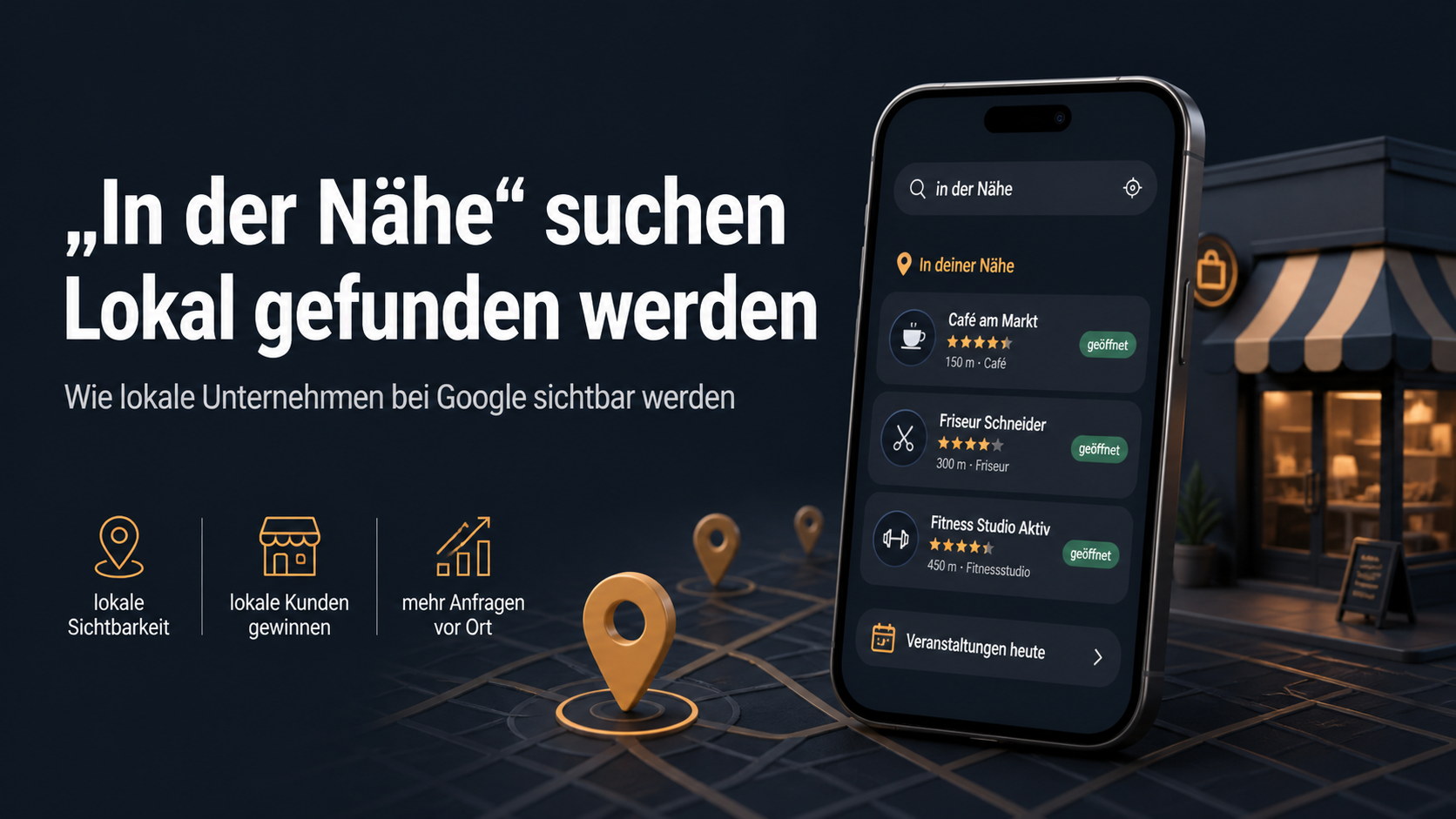
Why “Near Me” Searches Turn Into Local Customers

People searching “near me,” “open now,” or “events today” are not casually browsing. They are ready to choose. Here is how local businesses can turn those searches into real calls, visits, and bookings.
Behnam Khushab
Published on May 5, 2026
Local SEO · Website Strategy · High-Intent Google Searches
Why “Near Me” Searches Turn Into Local Customers
When someone searches “near me,” “open now,” “events today,” or even German phrases like “in der Nähe” and “Veranstaltungen heute,” they are usually not just researching. They are trying to make a decision. For local businesses, that moment is where visibility turns into revenue.
A local search is different from a general search. It is faster, more urgent, and much closer to action. A person looking for “best website examples” may be collecting ideas. A person searching “bakery open now” or “events near me today” is already moving toward a choice.
That is why recent search patterns around phrases such as “in der Nähe,” “geöffnet,” “Veranstaltungen heute,” “1 Mai Veranstaltungen in der Nähe,” and “haben Bäckereien am 1 Mai geöffnet” matter. They show what people do when they want something local, immediate, and trustworthy.
For a local business, the question is simple: when that search happens, does your business appear, look credible, and make the next step easy?
What “Near Me” Searches Really Tell You
The customer is close to action
Searches like “open now,” “near me,” and “events today” usually come from people who want to call, visit, book, reserve, or compare right away.
The decision is local
The user is not comparing every provider in the country. They are comparing the few businesses that appear nearby and look reliable.
Mobile experience matters
Many local searches happen on a phone. If your website loads slowly, hides the phone number, or makes booking difficult, the customer moves on.
Trust is built in seconds
People judge your business fast. Reviews, clear services, real photos, opening hours, location details, and a polished website all reduce doubt.
Why Local Visibility Is More Than Just “Ranking on Google”
Many business owners think local visibility starts and ends with showing up on Google Maps. That is only part of the picture. Your Google Business Profile may get the first impression, but your website often decides whether that impression becomes trust.
Imagine someone searching “events today” or “1 Mai Veranstaltungen in der Nähe.” If your business appears but the website is outdated, confusing, or missing key details, you lose momentum. If your page clearly shows the event, location, time, price, photos, and booking option, the user has fewer reasons to leave.
Local search is not just about being found. It is about being chosen after you are found.
The real goal:
Make it easy for Google to understand your business, and make it easy for people to take the next step once they land on your site.
Which Businesses Benefit Most From This Search Behavior?
Any business with a physical location, local service area, appointment flow, or regional customer base can benefit from local search. But some businesses are especially exposed to “near me” behavior because customers decide quickly.
Restaurants and cafés
Local searches often lead to table reservations, route clicks, menu views, calls, and walk-ins.
Bakeries and shops
Searches around “open now,” holiday hours, and nearby stores can turn directly into store visits.
Event venues
“Events today” and “events near me” searches are perfect for pages with schedules, tickets, and booking options.
Local service providers
Trades, clinics, consultants, repair services, and agencies can capture demand when people need a trusted option nearby.
Regional B2B firms
Companies in Saxony, Mittelsachsen, Chemnitz, Burgstädt, Freiberg, or nearby regions can build stronger regional authority.
Appointment-based businesses
Salons, practices, studios, and consultants need clear services, trust signals, and frictionless booking paths.
Your Website Is the Conversion Layer of Local Search
Your Google listing can get attention. Your website has to earn the decision.
When someone lands on your site from a local search, they are looking for quick confirmation. They want to know what you do, where you are, whether you are open, whether you look trustworthy, and how easy it is to contact you.
A strong local website does not force people to hunt. It answers the obvious questions fast and then guides the visitor toward one clear action: call, book, request a quote, reserve a table, buy a ticket, get directions, or send a message.
Five Website Moves That Help Local Customers Choose You
1. Build pages around real search intent
A homepage cannot carry every local search. If you offer multiple services, serve multiple towns, host events, or handle seasonal demand, you need dedicated pages. Each page should answer a specific question and lead to a specific action.
2. Make location signals obvious
Your site should clearly show where you are based, which areas you serve, and how customers can reach you. For regional companies, that may include places like Saxony, Mittelsachsen, Chemnitz, Burgstädt, Freiberg, Mittweida, or nearby towns when they are genuinely part of the service area.
3. Use seasonal searches before demand peaks
Searches like “1 Mai Veranstaltungen in der Nähe” and “haben Bäckereien am 1 Mai geöffnet” prove that local demand often spikes around dates, holidays, and events. If your pages are created after the search wave starts, you are already late. Build them early, update them clearly, and make them useful.
4. Put the next step where people can see it
If the user has to scroll too long to find a phone number, booking button, address, or contact form, the page is working against you. Local intent needs a short path. The stronger the intent, the less patience the visitor has.
5. Treat speed and mobile quality as revenue issues
A slow mobile site does not just create a technical problem. It creates a sales problem. Local customers often search while walking, driving, waiting, or comparing options quickly. A fast, clear mobile page keeps the decision moving.
Example: From “Events Today” to a Booking
Picture a restaurant, event space, cultural venue, or local organizer. People search for “events today,” “events near me,” or “1 Mai Veranstaltungen in der Nähe.” If your website only has a generic homepage, you make the user work too hard.
A stronger page shows the event title, date, start time, location, price, photos, parking notes, booking option, and contact details. It also works smoothly on a phone. That is how a search turns into a reservation, ticket sale, phone call, or store visit.
The same principle applies beyond events. A bakery can publish holiday opening hours. A clinic can create location-specific appointment pages. A service company can build pages for urgent problems in specific towns. The format changes, but the logic stays the same: match the search moment with a page that makes action easy.
Common Mistakes That Cost Local Businesses Leads
Outdated opening hours
If people search “open now” or “geöffnet” and your hours look unclear, outdated, or different across platforms, trust drops quickly.
One page for every service
A single generic page usually cannot rank or convert well for many different local needs. Clear service pages give users and search engines better signals.
Weak proof
Local customers want confidence. Reviews, real images, team information, references, and clear explanations make the business feel safer to choose.
Poor mobile layout
If buttons are too small, forms are frustrating, or text is hard to read, the user may not complain. They will simply choose someone else.
Where Olymaris Fits In
Olymaris helps businesses turn websites into stronger digital assets. For local search, that means more than adding a few keywords. It means shaping the structure, content, design, speed, and user journey so the website supports real business outcomes.
Depending on the situation, that may involve building new service pages, improving mobile performance, refreshing an outdated site, creating stronger local landing pages, cleaning up technical SEO, or connecting search visibility with better conversion paths.
A Simple Local Visibility Checklist
If you want to know whether your website is ready for local search traffic, start with these questions:
- 1 Can a visitor understand what you do and where you operate within five seconds?
- 2 Are your phone number, address, opening hours, and main action easy to find on mobile?
- 3 Do your important services, locations, or seasonal offers have their own clear pages?
- 4 Does your website support searches like “near me,” “open now,” “events today,” and “in der Nähe”?
- 5 Is there a clear next step: call, book, reserve, request a quote, get directions, or send a message?
How This Supports Your Larger Website Strategy
This topic should not sit alone. It belongs inside a larger website content cluster because local search depends on the same foundations that make any business website perform: clean structure, useful pages, credible messaging, fast loading, and strong calls to action.
If your business is planning a larger website project, start with the broader strategy first. Then use local search articles like this one to support more specific needs such as location pages, event pages, opening-hour content, seasonal pages, and service-area pages.
Bottom Line: Local Searches Are Buying Signals
Searches like “near me,” “open now,” “events today,” “in der Nähe,” and “geöffnet” are not just traffic opportunities. They are buying signals. They tell you that someone nearby has a need, a timeline, and a reason to act.
If your business appears at that moment with a fast, clear, trustworthy website, you have a real chance to win the call, visit, booking, or inquiry. If your site is slow, vague, outdated, or hard to use, that opportunity goes to a competitor.
Local visibility is not a side project. For many businesses, it is one of the shortest paths from search demand to real revenue.
Comments
0 published comments
No approved comments have been published yet.
Recommended Articles
Fresh insights from our blog

AI Automation for Small Businesses: What Is Actually Worth It?
Not every AI idea is worth the effort. This guide shows small businesses which workflows are worth automating first, how to judge readiness,...

CRM for Small Businesses: A Practical Guide to Starting Simple
A practical guide for owners and managers who want a simple CRM without turning sales into a software project. Learn when a CRM is worth it,...

Turn Your Website Into a Sales Machine: More Leads and Revenue
A practical guide for small businesses that want their website to do more than look good. Learn how clearer messaging, stronger trust, bette...

Medical Practice Website: Booking, Forms, Costs
A practical guide to building a medical practice website that helps patients book online, submit forms, and understand what affects cost.

Driver Tracking for Small Transport Companies: Features and Costs
A practical guide to driver tracking for small transport companies: what it does, what to look for, and how to think about cost and rollout.

Holiday Apartment Website with Booking System: What Owners Really Need
A practical guide for holiday apartment and serviced apartment owners who want a booking website that shows availability, builds trust and t...