

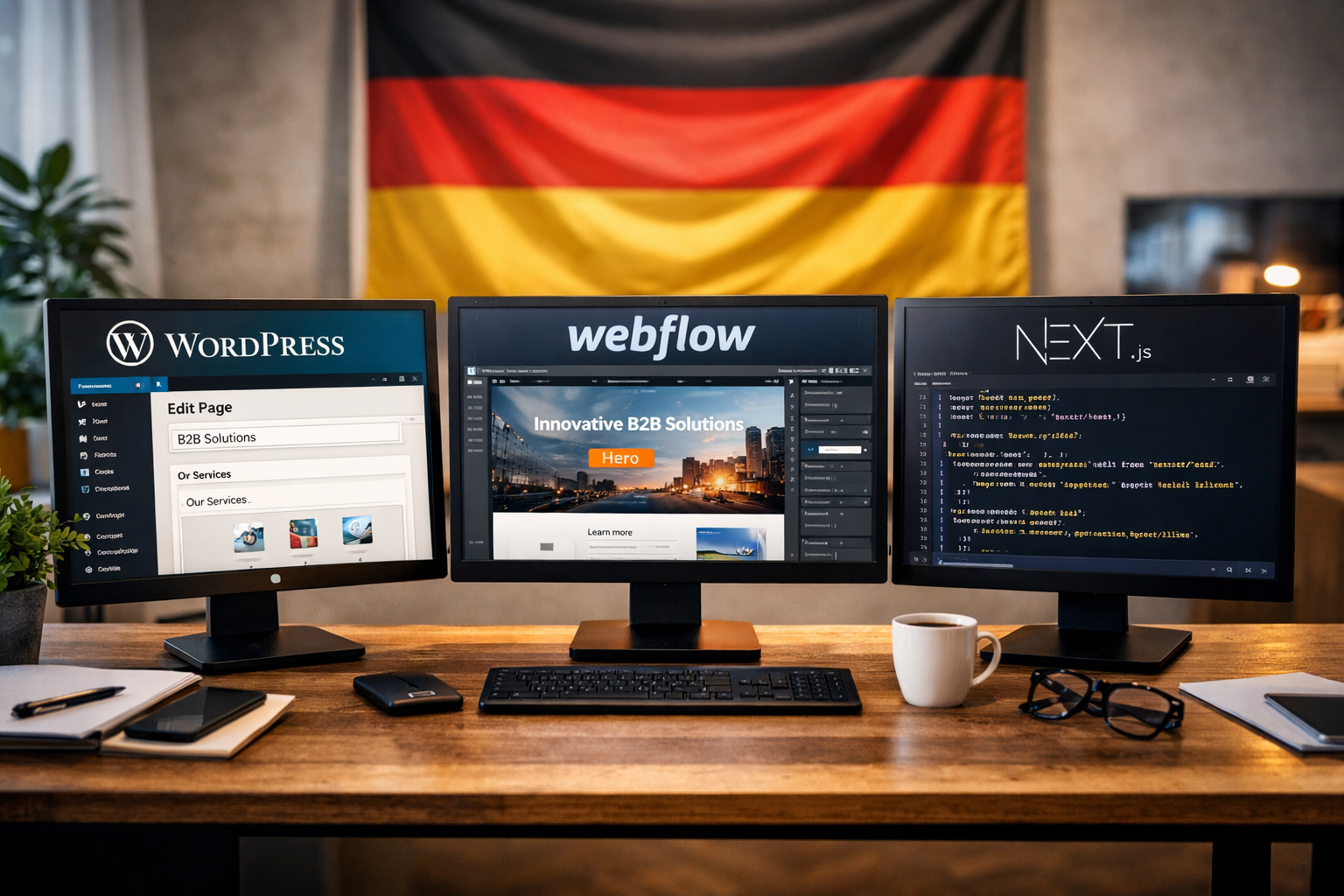
WordPress vs Webflow vs Custom Next.js: What’s Best for a B2B Website in Germany (Cost, SEO, Maintenance)

If you run a B2B company in Germany, you’ve probably asked yourself a version of this question: “Should we build our site on WordPress or Webflow in Germany – or is it finally time to invest in a custom Next.js website?” The wrong decision can lock your marketing and sales into a rigid, fragile platform for three to five years; the right one turns your website into a predictable lead-generation engine and a real digital asset. In this article, we compare WordPress, Webflow and custom Next.js for B2B websites in Germany from every angle that matters: development cost, maintenance cost, SEO performance, speed, scalability, headless CMS options, security and agency support. You’ll also get a practical decision framework and references to in-depth guides from Olymaris on website cost, timelines, maintenance and modern web design.
Behnam Khushab
Published on December 24, 2025 · Updated April 28, 2026
Optional external content
This media loads from an external source and stays blocked until you accept optional cookies.
Introduction
This Decision Will Shape Your B2B Future in Germany
Imagine you're a managing director or marketing lead in a German B2B company – industrial supplier, B2B SaaS, consulting, or engineering. Your current website looks outdated, loads slowly on mobile and delivers almost no qualified leads. Paid ads are getting more expensive, and your sales team keeps hearing the same sentence from prospects:
"We checked your website and weren't really sure what you do."
Now you're stuck between three options:
- Rebuild the site on WordPress with a German WordPress agency
- Move to Webflow because the marketing team wants more control
- Or invest in a custom Next.js website that everyone says is "the future" for performance and SEO
Most companies in Germany oversimplify the question to: "WordPress vs Webflow – which is cheaper?"
That's how they end up rebuilding the same website again in three years.
The real question should be:
Which B2B website platform will support our sales and marketing strategy in Germany for the next 3–5 years – WordPress, Webflow or a custom Next.js website?
This article gives you a clear, strategic answer.
A Quick Executive Summary for Busy Decision-Makers
If you only have a few minutes, here is the short version:
WordPress in Germany
Good for B2B companies that need a flexible, content-heavy website with blogging, case studies and landing pages, and who want access to a large ecosystem of plugins and agencies. Works well if you choose a professional agency and commit to ongoing maintenance.
Webflow in Germany
Great for design-driven B2B brands and marketing teams who want to launch and iterate landing pages fast without relying on developers all the time. Ideal for websites that are more "front-end heavy" and do not require complex back-end logic.
Custom Next.js website
The right choice when your website is more than a brochure: complex B2B funnels, portals, deep CRM integration, multi-language content, and long-term SEO performance. Higher initial development cost, but a strong strategic asset over 3–5 years.
If you want to understand what realistic costs and services you should expect when having a website built professionally, read this cluster hub article from Olymaris:
https://www.olymaris.com/blog/having-a-website-built-what-costs-and-services-should-you-really-expectBefore You Choose a Platform, Define the Game Properly
Most discussions about "WordPress vs Webflow Germany" or "custom Next.js website" start with technology. That's a mistake.
You should start with business reality:
- What role should your B2B website play in the next 3 years?
- How aggressive is your growth and lead generation target in Germany and Europe?
- How complex are your sales processes and internal systems?
From there, you define the selection criteria. For a B2B website in Germany, at minimum:
Initial development cost
This is not just design and coding. It must include strategy, UX, information architecture, content structure, SEO setup and analytics.
Ongoing maintenance cost (real TCO)
The "Total Cost of Ownership" includes security updates, bug fixing, performance optimizations, feature additions, content updates and support.
For a deep dive into real monthly packages and what's actually included in Germany, see: Website Maintenance Guide
SEO performance and speed
Core Web Vitals, mobile UX, technical SEO and site structure directly influence how visible you are on Google Germany – and whether your website becomes a lead-generation engine or just an online brochure.
To better understand what "modern web design" really means today, look at: What Does Modern Web Design Really Mean
Security and risk
Especially for WordPress, plugin choices and update discipline are crucial. A hacked B2B website in Germany means much more than downtime – it hits your reputation.
Scalability and future development
Do you only need a marketing website, or will you later add customer portals, partner areas, calculators, dashboards and custom workflows?
CMS and headless CMS options
If you plan to publish content across multiple channels (website, landing pages, apps), a headless CMS with a custom Next.js front-end can avoid content chaos.
Germany-specific compliance (GDPR, BFSG, EAA)
Your platform must make it easier – not harder – to implement privacy, consent and accessibility requirements.
For a practical checklist and audit process, refer to: BFSG Accessibility Checklist
With this checklist in mind, we can now analyze WordPress, Webflow and Next.js properly.
WordPress for B2B Websites in Germany: Flexible, Powerful – If Done Right
WordPress has dominated the CMS world for years. In Germany, a huge share of B2B websites runs on it. That's not automatically a recommendation; it just means you're in a very crowded ecosystem.
Advantages of WordPress for B2B in Germany:
Massive ecosystem
Countless plugins exist for lead capture, forms, SEO, multilingual support, CRM integration and more. For a typical B2B website platform with blogs, case studies and service pages, WordPress can cover almost everything.
Strong for content and SEO
If your strategy is to publish high-quality B2B content, thought leadership and case studies, WordPress can be very effective. With the right setup, it can deliver strong SEO performance.
Many agencies and freelancers in Germany
You can find WordPress agencies at every price level. That gives you choice – but also risk.
Lower entry cost (at least on paper)
WordPress projects usually start cheaper than custom Next.js builds. For many SMEs, this seems attractive – until hidden costs show up.
Risks and downsides:
Security issues through bad plugins and themes
A large chunk of WordPress security problems comes from low-quality plugins, outdated themes and poor maintenance. For B2B companies working with sensitive data and enterprise customers, one breach is enough to burn a lot of trust.
Performance problems with "cheap" setups
If your site is built on a bloated, pre-made theme with 30 plugins, your Core Web Vitals will suffer. That directly damages your SEO performance in Germany.
Hidden maintenance cost
Initially, the project looks cheap. Then, every minor change needs developer time. Every plugin update risks breaking something. Over a few years, the maintenance cost can surpass the initial project budget.
If you want to see how "cheap web design" vs "professional web design" shapes your business future, read:
The Real Difference Between Cheap and Professional Web DesignConclusion: WordPress is a strong option for many B2B websites in Germany – but only if you choose a professional agency, approve a clean architecture (not a messy theme), and sign a clear maintenance agreement.
Webflow for B2B Websites in Germany: Marketer-Friendly, Design-Driven
Webflow has grown popular in Germany especially among startups and modern B2B brands. The core promise: design freedom, clean front-end output and more control for marketing.
Advantages of Webflow for B2B:
Fast design and implementation
Designers and marketers can build and adjust pages directly. For teams running frequent campaigns and AB tests, this is a huge advantage.
Clean HTML/CSS output
When used correctly, Webflow can deliver fast, lean front-end code with solid Core Web Vitals – good for SEO performance.
Built-in CMS for structured content
For blogs, case studies and product pages, Webflow's CMS works well, as long as your structure is not overly complex.
Limitations of Webflow:
Limited for very complex, system-like projects
Once your needs move from "website" to "web application" (customer portals, complex forms, deep business logic), Webflow becomes a constraint. You will sooner or later need a custom solution, typically with something like Next.js.
Vendor lock-in
Hosting, infrastructure and some parts of the stack are controlled by Webflow. For some German companies with strict internal IT policies and hosting requirements, this is a real concern.
Back-end complexity
Any advanced server-side logic, workflows or integrations will require additional services and developers, which reduces the simplicity advantage.
Conclusion: If your B2B website in Germany is design-driven, campaign-heavy and not extremely complex on the back-end, Webflow is a very attractive choice – especially for marketing teams that want agility.
Custom Next.js Website: When Your Site Is a Strategic Asset
A custom Next.js website is the heavyweight option. It's not for everyone – and that is exactly why it's powerful when needed.
Next.js makes sense when:
- • Your website is part of a larger digital platform – Think of customer portals, partner areas, dashboards, calculators, configurators and custom B2B workflows.
- • You need deep integration – CRM, ERP, marketing automation, custom APIs, SSO – the more integrated your digital ecosystem, the more sense a custom Next.js front-end makes.
- • Multi-language and multi-market are critical – Multiple languages (DE / EN / others), complex navigation, varying content by market and role – this is where Next.js with a proper architecture shines.
Key advantages of Next.js for B2B in Germany:
Full control over architecture, speed and SEO
You decide how pages are rendered (SSR, SSG, ISR), how routing works, how fast the site is and how deep your technical SEO goes.
Powerful with headless CMS
Connect Next.js to a headless CMS (Contentful, Storyblok, Sanity, Strapi, etc.) and you have one content source for your website, landing pages or even apps.
Long-term scalability
You can start with a "simple" marketing website and grow it into a full digital platform without being forced to rebuild everything on a new stack.
Strong security and governance
Fewer random plugins, more control over dependencies and infrastructure, and easier alignment with internal security policies.
Disadvantages:
Higher upfront cost
A custom Next.js website requires a skilled team and more time. It's an investment – not a quick fix.
Higher complexity if badly managed
If the codebase is not properly architected or documented, onboarding new developers later becomes slow and expensive.
Conclusion: A custom Next.js website makes the most sense when you see your B2B website in Germany as a strategic asset that must grow with your business, not just as a static marketing page.
Direct Comparison: WordPress vs Webflow vs Next.js for B2B Germany
Now, let's compare all three on the main axes.
Development cost
WordPress
Usually the cheapest entry point – but with a huge quality range. A "cheap template site" and a "professionally planned corporate website" are completely different products.
For realistic cost structures and service expectations, see: Cost Guide
Webflow
Often mid-range initial cost. Fast design and build cycles can reduce overall budget for visually strong sites with moderate complexity.
Next.js
Highest initial investment, because you are building a custom B2B website platform – not just a site. But over 3–5 years, it can be the most economical if it replaces multiple tools and rebuilds.
Maintenance cost
WordPress
Needs regular core, theme and plugin updates. Without maintenance, security and performance degrade. German agencies typically offer monthly maintenance packages.
Webflow
You pay for Webflow hosting and plans. Infrastructure updates are handled for you. Marketing can change content without a developer; complex features still require development.
Next.js
Maintenance focuses on infrastructure, dependencies and continuous improvements. If the architecture is well thought out, the cost per business value over time is favorable.
For a realistic look at website maintenance in Germany, read:
Website Maintenance Guide 2026SEO performance and Core Web Vitals
To turn your website into a lead-generation engine, technical SEO and UX matter as much as content.
This article from the cluster explains how typical corporate websites fail and how to fix them:
10 Common Corporate Website MistakesWordPress
Can perform very well if you avoid bloated themes and plugin overload and work with a professional developer.
Webflow
Good baseline for performance and clean front-end when used with discipline.
Next.js
Offers the strongest control for high-performance SEO setups in competitive B2B niches.
For a deeper understanding of "modern web design" and mobile-first:
Scalability and complexity
WordPress
Excellent for classic corporate sites and blogs. But as complexity grows, plugin stacking becomes a fragile solution.
Webflow
Perfect for design-heavy marketing sites, limited for complex applications.
Next.js
Built for complexity and growth. It's the natural choice when your website becomes a core business system.
Content structure and CMS
If you don't know what content your corporate website should have, the platform won't save you. Start here:
Essential Content Every Corporate Website Must HaveHeadless CMS + Next.js is typically the best choice when:
- You manage content for multiple markets and channels
- You want clean separation between content and presentation
- Multiple teams contribute to and reuse content
Germany-Specific Factors: Law, Accessibility, Mobile
Germany is not "just another market". Your B2B website must align with:
- GDPR and strict data protection expectations
- BFSG / European Accessibility Act requirements
- A cultural expectation of quality and professionalism
If your platform choice makes it hard to implement accessibility and legal requirements, you are building risk into your digital presence.
The following guide gives you a checklist and process for German SMEs:
BFSG Website Accessibility Checklist 2026Decision Framework: Which Option Should You Choose?
Let's simplify the decision into three typical scenarios.
Scenario 1 – Small to mid-sized B2B, simple structure, limited budget
Goal:
A modern, fast, credible website that generates leads but has no complex system requirements yet.
Best options:
- Professional WordPress implementation
- or Webflow site with strong UX, content and SEO
Non-negotiables:
- Mobile-first responsive design
- Clear information architecture
- Professionally written content and case studies
- Basic technical SEO and analytics setup
Scenario 2 – Growing B2B brand, multiple markets, increasing complexity
Goal:
A B2B website platform that supports international marketing, lead gen and some integrations.
Best options:
- High-quality WordPress or Webflow implementation for the current stage
- But with a clear architectural path towards a future custom Next.js website
Scenario 3 – B2B company with complex sales process and portals
Goal:
A digital platform – not just a website – that supports portals, self-service, partner access and deep system integration.
Best option:
Custom Next.js website with a headless CMS and proper integration architecture from day one.
In all scenarios, one truth remains:
The agency you choose matters more than the technology you choose.
Cheap, template-based work on any platform will produce a fragile, underperforming website. A strategic, well-architected implementation turns WordPress, Webflow or Next.js into a real growth asset.
For more context on timelines and execution quality, see:
How Olymaris Supports Your Decision Between WordPress, Webflow and Next.js
Olymaris is not "married" to a single platform. We work with WordPress, Webflow and Next.js – which means we have no interest in forcing you into one technology that doesn't fit your future.
Our typical approach with B2B companies in Germany:
Clarify your 3-year digital and sales strategy
What should your website achieve in terms of leads, positioning and integration?
Map your requirements to a realistic platform strategy
That may mean a professional WordPress or Webflow implementation today, with a roadmap towards a custom Next.js website tomorrow.
Deliver everything as one coherent project
Strategy, UX, design, development, content, SEO and maintenance – not isolated pieces.
The result: you don't just "get a website". You get a B2B website platform that matches your ambitions and won't need to be rebuilt every time your company grows.
FAQ – WordPress vs Webflow vs Next.js for B2B Websites in Germany
Q1: For a B2B website in Germany, is WordPress or Webflow better?
It depends on your complexity and your team. If your site is mainly content-driven (services, blog, case studies) and you want maximum flexibility and plugin choice, a professionally built WordPress site is very strong. If your marketing team wants fast control over pages and your technical complexity is moderate, Webflow is an excellent option.
Q2: When does it make sense to move from WordPress or Webflow to Next.js?
When your website needs to behave like a platform, not just a site: customer portal, complex quoting, deep CRM integration, multi-language with complex rules and strict performance/SEO requirements. At that point, patching WordPress or Webflow becomes more expensive than building a custom Next.js website.
Q3: Which platform is best for SEO performance in Germany?
All three can perform well if built correctly. WordPress with a lean theme and good SEO plugins, Webflow with clean front-end code, and Next.js with SSR/SSG can all achieve strong rankings. In very competitive B2B niches, a custom Next.js website gives you the most control over technical SEO and Core Web Vitals.
Q4: What are realistic maintenance costs for each platform?
WordPress usually needs a structured maintenance package for updates and security, plus development time for features. Webflow requires subscription fees and occasional development for custom features. Next.js involves maintaining infrastructure and code over time.
For concrete ranges in the German market, see: Website Maintenance Guide
Q5: Which option is better for a multi-language B2B website in Germany?
For a simple DE/EN setup, both WordPress and Webflow can work well. If you plan several languages, complex content variations and reuse across channels, a headless CMS with a custom Next.js front-end is usually the most robust solution.
Q6: Can we start with WordPress or Webflow and later migrate to Next.js?
Yes – and in many cases, that's the smartest strategy. Start with a professional WordPress or Webflow site, but design your content structure, URLs and SEO in a way that makes a future migration safe. A strategic partner like Olymaris can design your initial site so that moving to a custom Next.js website later doesn't destroy your existing rankings and traffic.
Q7: Our budget is limited but we don't want to make a strategic mistake. What should we do?
In that case, the key is to start lean but strategic. Choose a professional, minimal WordPress or Webflow setup, invest in proper content and SEO, and work with an agency that understands how to keep the door open for a future migration to Next.js and a headless CMS. This way, you avoid being locked into a dead-end platform while still respecting your budget today.
Ready to Make the Right Decision for Your B2B Website?
Don't let your website become a bottleneck for growth. Let's discuss which platform strategy – WordPress, Webflow, or Next.js – will support your business goals for the next 3-5 years.
Get expert guidance tailored to your B2B company in Germany
Comments
0 published comments
No approved comments have been published yet.
Recommended Articles
Fresh insights from our blog

AI Automation for Small Businesses: What Is Actually Worth It?
Not every AI idea is worth the effort. This guide shows small businesses which workflows are worth automating first, how to judge readiness,...

CRM for Small Businesses: A Practical Guide to Starting Simple
A practical guide for owners and managers who want a simple CRM without turning sales into a software project. Learn when a CRM is worth it,...

Turn Your Website Into a Sales Machine: More Leads and Revenue
A practical guide for small businesses that want their website to do more than look good. Learn how clearer messaging, stronger trust, bette...

Medical Practice Website: Booking, Forms, Costs
A practical guide to building a medical practice website that helps patients book online, submit forms, and understand what affects cost.

Driver Tracking for Small Transport Companies: Features and Costs
A practical guide to driver tracking for small transport companies: what it does, what to look for, and how to think about cost and rollout.

Holiday Apartment Website with Booking System: What Owners Really Need
A practical guide for holiday apartment and serviced apartment owners who want a booking website that shows availability, builds trust and t...