


Holiday Apartment Website with Booking System: What Owners Really Need

A practical guide for holiday apartment and serviced apartment owners who want a booking website that shows availability, builds trust and turns guest interest into reservations.
Olymaris Team
Published on May 23, 2026 · Updated June 2, 2026
Holiday Apartments · Booking System · Guest Experience
Holiday Apartment Website with Booking System: What Owners Really Need
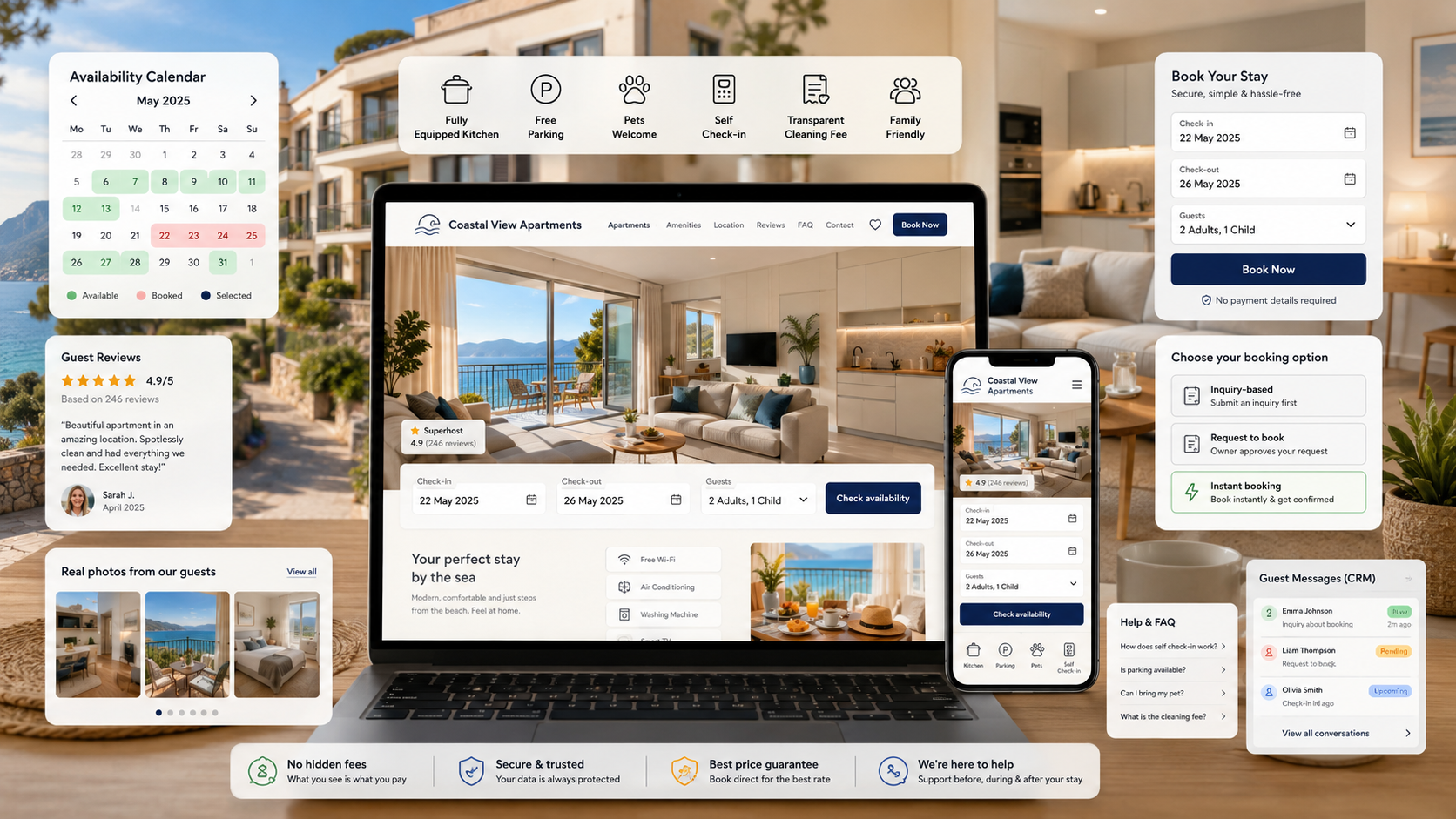
A holiday apartment website should do more than display beautiful photos. It should help guests choose the right unit, understand the rules, check availability and take the next step without sending five emails back and forth.
Holiday Apartments Need a Different Booking Experience
A holiday apartment, vacation rental or serviced apartment is not sold exactly like a standard hotel room. Guests often stay longer, compare amenities more carefully and care about details such as kitchen equipment, parking, cleaning fees, self check-in, pet rules and distance to local attractions.
This means your website has to answer practical questions before the guest asks them. If the information is missing, unclear or hidden in long text, the guest may hesitate or move to another property that feels easier to book.
A good booking website reduces uncertainty. It gives guests enough confidence to submit an inquiry, reserve a stay or contact your team with a very specific request.
What Should a Holiday Apartment Website Include?
The goal is simple: make the apartment easy to understand and easy to book. The website should guide the guest from interest to action without making them search for basic details.
Clear unit pages
Each apartment should have its own page with photos, capacity, beds, amenities, location notes and ideal guest type.
Availability calendar
Guests should quickly see whether the unit may be available for their dates before they send a request.
Transparent stay details
Cleaning fee, minimum nights, check-in, check-out, deposits and house rules should be visible early.
Simple inquiry or booking form
The form should collect the right details without feeling like paperwork: dates, guests, contact details and special requests.
The Booking System Should Match How You Work
Not every holiday apartment business needs the same booking setup. Some owners want instant booking with online payment. Others prefer request-based booking because they need to check availability, guest fit or long-stay conditions before confirming.
The right system depends on your operation. A single apartment may need a clean inquiry flow and calendar. A serviced apartment provider with multiple units may need filters, unit categories, recurring guest profiles and structured follow-up.
Inquiry-based
Best when you want to qualify guests, confirm details manually or handle custom stays.
Request to book
Best when guests choose dates and unit details, but your team confirms before final booking.
Instant booking
Best when pricing, availability, rules and payment are clear enough to automate confirmation.
Where Many Apartment Websites Lose Guests
The guest is interested, but the website does not answer the final questions. Is parking included? Is the kitchen fully equipped? Can children stay? Are pets allowed? Is there a cleaning fee? Can the guest arrive late?
These small doubts create friction. A better website turns those doubts into clear sections, helpful FAQs and a booking form that captures the right information from the start.
Request a website reviewContent That Helps Guests Decide Faster
A holiday apartment website should not only describe the property. It should help the guest imagine the stay. This is where strong content has a direct business impact.
1. Show who the apartment is best for
A couple, a family with children, a business traveler and a long-stay guest look for different things. Make it clear who each unit fits best.
2. Explain the location in practical terms
Do not only mention the city. Explain distance to the train station, business areas, hiking routes, event venues, restaurants, parking options and public transport.
3. Make rules easy to understand
House rules should not feel hidden. Clear rules protect your property and help guests avoid surprises.
4. Add trust before the booking form
Reviews, real photos, host information, secure contact options and transparent policies make direct inquiries feel safer.
For the broader hotel website strategy, including direct booking, integrations and costs, read the main guide: Hotel Website with Direct Booking: Features, Channel Manager and Costs .
Why CRM Matters for Apartment Inquiries
Holiday apartment inquiries often include special details: arrival time, number of guests, children, pets, long-stay requests, invoice needs or questions about local access. If these messages stay scattered across inboxes, follow-up becomes slow and inconsistent.
A simple CRM workflow helps your team track guest requests, reply faster and keep useful information for future stays. This is especially valuable for serviced apartments, repeat business travelers and long-stay guests.
Explore CRM for small businessesFAQ: Holiday Apartment Website with Booking System
Does a holiday apartment need instant booking?
Not always. Many owners start with a request-based booking flow because it gives them more control. Instant booking is useful when availability, pricing and rules are highly standardized.
What information should every apartment page show?
Each page should show capacity, beds, amenities, photos, location benefits, stay rules, fees, availability guidance and a clear booking or inquiry action.
Can a website handle several apartments?
Yes. A well-structured website can include filters, unit categories, separate calendars, inquiry forms and landing pages for different guest types.
Comments
1 published comments
Matthias
Hallo, ich habe eine Ferienwohnung und interessiere mich für eine Website mit Buchungssystem. Können Sie mir ungefähr sagen, mit welchen Kosten ich für so ein System rechnen muss? Vielen Dank!
Admin reply
Hallo Matthias, vielen Dank für Ihre Anfrage. Die Kosten hängen stark von Ihren genauen Anforderungen und dem gewünschten Funktionsumfang ab. In der Basisversion beginnt eine Website mit Buchungssystem bei ca. 1.200 €. Zusätzlich können separate SaaS-Gebühren für einen Channel Manager bzw. ein Channel-Management-System anfallen, wenn die Buchungen mit anderen Buchungsplattformen synchronisiert werden sollen. Diese Kosten sind unabhängig von der Website. Die Umsetzung dauert in der Regel etwa 45 Arbeitstage.
Recommended Articles
Fresh insights from our blog

AI Automation for Small Businesses: What Is Actually Worth It?
Not every AI idea is worth the effort. This guide shows small businesses which workflows are worth automating first, how to judge readiness,...

CRM for Small Businesses: A Practical Guide to Starting Simple
A practical guide for owners and managers who want a simple CRM without turning sales into a software project. Learn when a CRM is worth it,...

Turn Your Website Into a Sales Machine: More Leads and Revenue
A practical guide for small businesses that want their website to do more than look good. Learn how clearer messaging, stronger trust, bette...

Medical Practice Website: Booking, Forms, Costs
A practical guide to building a medical practice website that helps patients book online, submit forms, and understand what affects cost.

Driver Tracking for Small Transport Companies: Features and Costs
A practical guide to driver tracking for small transport companies: what it does, what to look for, and how to think about cost and rollout.

Hotel Website with Direct Booking: What It Needs
A practical guide for hotel owners and managers who want more direct bookings, clearer guest journeys, and a website that supports sales.