


Rent vs Shopify, WooCommerce, or Custom Build

Compare the real business trade-offs of renting an online shop versus Shopify, WooCommerce, or a custom build so you can choose faster and with less risk.
Olymaris Team
Published on June 4, 2026
Online Shop
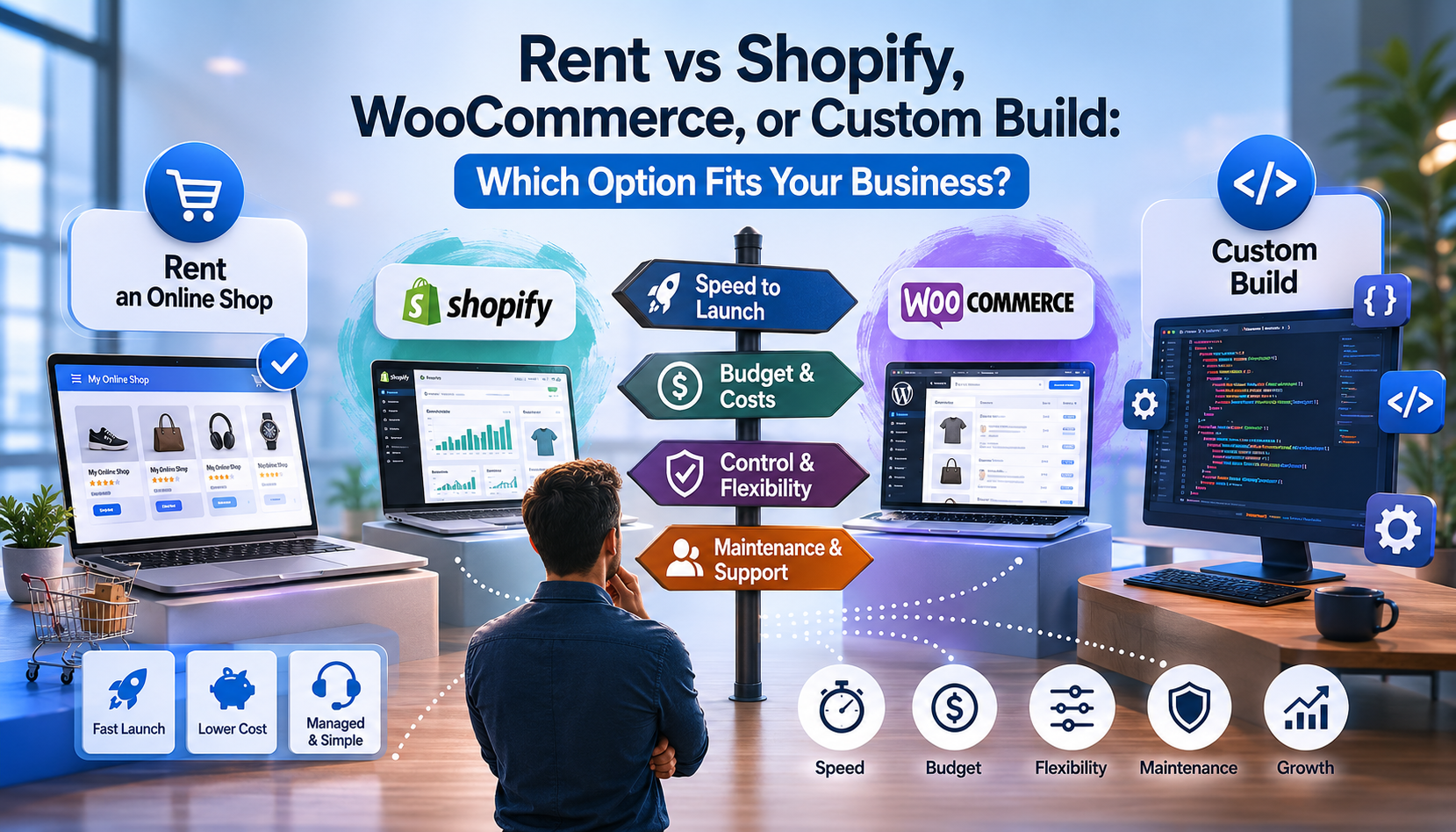
Rent vs Shopify, WooCommerce, or Custom Build: Which Option Fits Your Business?
If you want to sell online, the real question is not only which platform is popular. It is which setup helps your business launch on time, stay within budget, and avoid technical work that slows sales down.
Best for fast decisions
A rented shop is often the simplest choice when you want a managed setup, predictable monthly costs, and a quicker start.
Best for more control
Shopify, WooCommerce, or a custom build can make sense when you already know your process, your budget, and your long-term feature needs.
The short answer for small businesses
If your main goal is to start selling without a long setup phase, renting an online shop is usually the most practical first step. It reduces the pressure on your team because hosting, technical setup, and ongoing maintenance are handled as part of the service. That matters when you need to focus on products, pricing, and customer acquisition instead of platform administration.
Shopify is often attractive for businesses that want a well-known SaaS platform and are comfortable working inside its structure. WooCommerce can suit teams that already use WordPress and want more flexibility, but it also means more responsibility for plugins, updates, and technical upkeep. A custom build is the most flexible option, but it usually demands the highest budget, the longest timeline, and the clearest internal requirements.
How the options differ in business terms
Renting an online shop
This model is useful when you want a ready-to-use shop, a lower upfront commitment, and a clear path to launch. It is especially helpful for businesses that want to test demand before investing in a larger build.
Shopify or WooCommerce
These platforms can work well if you want to own more of the setup decisions. The trade-off is that your team still needs to manage design choices, integrations, and the ongoing work that keeps the shop stable.
Custom development
A custom build is worth considering when your business process is unusual, your requirements are specific, or your growth plan depends on features that standard systems cannot cover cleanly.
Questions managers should ask before choosing
- How quickly do we need to go live?
- How much internal time can we spend on setup and maintenance?
- Do we need a simple launch now, or a highly tailored system later?
- What is our realistic budget for the first year?
- Who will handle product updates, content, and technical issues?
These questions matter because the cheapest option on paper is not always the least expensive in practice. A platform that looks affordable can still create hidden costs through plugins, support work, redesigns, or delayed launch decisions.
When a rented shop is the smarter first move
A rented shop is often the better choice when you want to validate demand, keep the project manageable, and avoid a long technical planning phase. It can also help smaller teams move faster because the setup is already structured and the operational burden is lower.
If you later need more advanced features, you can still review the next step with a clearer view of sales, customer behavior, and internal capacity. That makes the first decision less risky and more business-driven.
For a broader overview of the rental model, see the main guide to online shop rental. If you want to compare the financial side in more detail, the related article on renting or building an online shop is a useful next read.
How the Online Shop service supports this decision
The Online Shop service is designed for businesses that want a managed shop environment instead of building everything from scratch. That makes it easier to start with a clear scope, a predictable setup, and a technical foundation that does not demand constant internal troubleshooting.
This is especially useful for owners who want to focus on commercial decisions: which products to launch first, how to present the offer, and how to keep the first sales process simple enough for the team to handle.
A practical way to decide
Choose renting if speed, simplicity, and lower operational load matter most. Choose Shopify or WooCommerce if you want a platform you can shape more directly and you are ready to manage more of the setup yourself. Choose custom development only when your business case is strong enough to justify the time and cost.
The best option is the one that matches your current stage, not the one that sounds most impressive in theory.
Next step: talk through your shop setup
If you are deciding between renting, Shopify, WooCommerce, or a custom build, we can help you compare the options against your budget, timeline, and growth plan.
Comments
0 published comments
No approved comments have been published yet.
Recommended Articles
Fresh insights from our blog

AI Automation for Small Businesses: What Is Actually Worth It?
Not every AI idea is worth the effort. This guide shows small businesses which workflows are worth automating first, how to judge readiness,...

CRM for Small Businesses: A Practical Guide to Starting Simple
A practical guide for owners and managers who want a simple CRM without turning sales into a software project. Learn when a CRM is worth it,...

Turn Your Website Into a Sales Machine: More Leads and Revenue
A practical guide for small businesses that want their website to do more than look good. Learn how clearer messaging, stronger trust, bette...

Medical Practice Website: Booking, Forms, Costs
A practical guide to building a medical practice website that helps patients book online, submit forms, and understand what affects cost.

Driver Tracking for Small Transport Companies: Features and Costs
A practical guide to driver tracking for small transport companies: what it does, what to look for, and how to think about cost and rollout.

Holiday Apartment Website with Booking System: What Owners Really Need
A practical guide for holiday apartment and serviced apartment owners who want a booking website that shows availability, builds trust and t...